
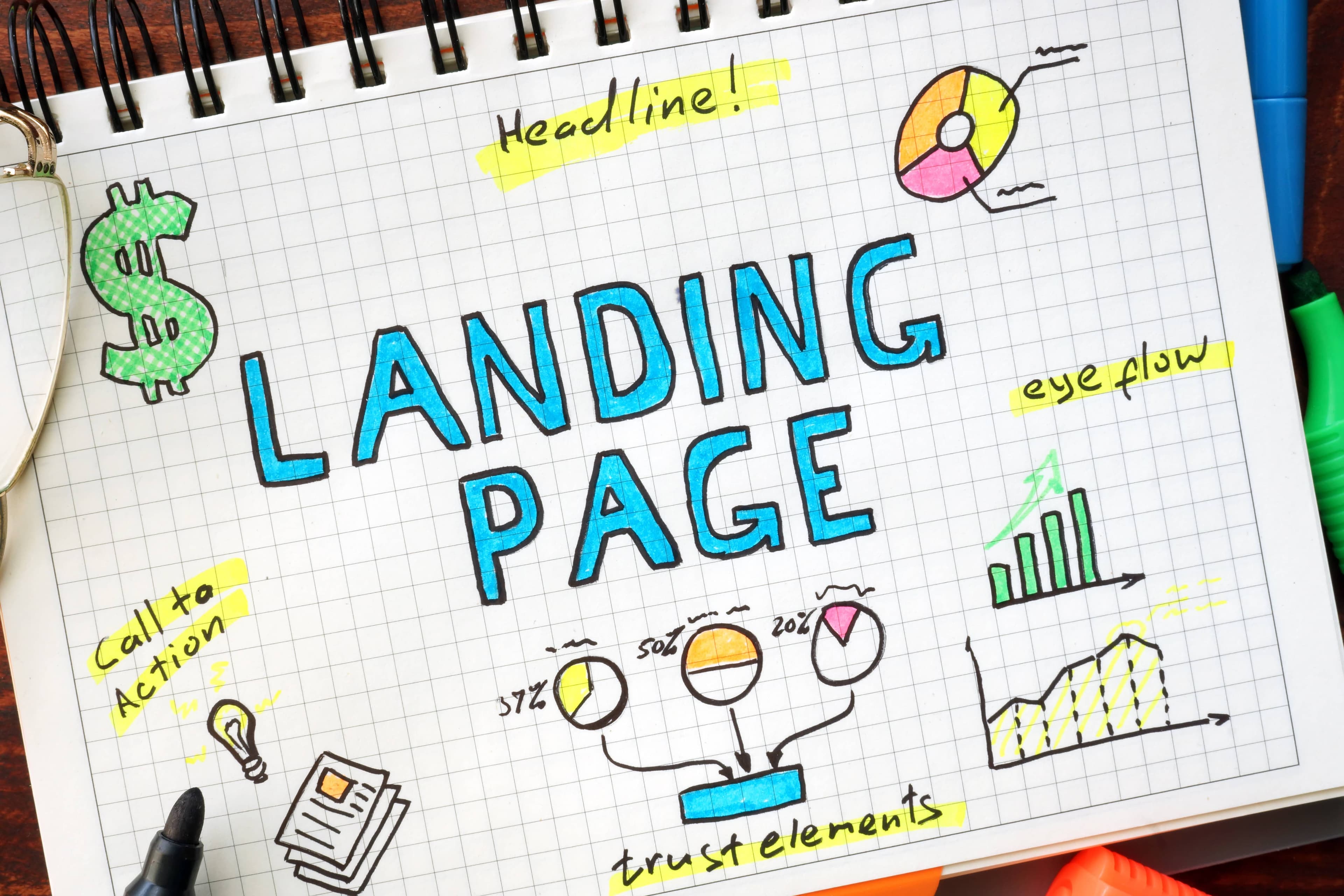
The Psychology of High-Converting Landing Pages
You have about 8 seconds. That's how long visitors typically spend deciding whether your landing page is worth their time. In those 8 seconds, dozens of psychological processes fire, some conscious, most not, determining whether they'll scroll, click, or bounce.
The difference between a landing page that converts at 2% and one that converts at 12% isn't luck or magic. It's understanding how people actually make decisions online and designing for those realities.
Let's break down the psychology that separates high-converting landing pages from expensive experiments.
The First Impression: Above the Fold
The "fold" is the portion of your page visible without scrolling. It's prime real estate, and what you put there shapes everything that follows.
Visual Hierarchy: Guiding the Eye
Humans don't read web pages. They scan them in predictable patterns. Eye-tracking studies consistently show two dominant patterns:
F-Pattern: Users scan horizontally across the top, move down, scan horizontally again (shorter), then scan vertically down the left side.
Z-Pattern: For simpler pages, eyes move from top-left to top-right, diagonally to bottom-left, then across to bottom-right.
Design your above-the-fold content to work with these patterns:
┌─────────────────────────────────────────┐
│ LOGO          NAV    NAV    NAV    CTA  │ ← First scan
├─────────────────────────────────────────┤
│                                         │
│     HEADLINE (Largest, Most Prominent)  │ ← Primary focus
│                                         │
│     Subheadline explaining value        │ ← Secondary focus
│                                         │
│         [ Primary CTA Button ]          │ ← Action point
│                                         │
│     Trust indicators (logos, stats)     │ ← Credibility
│                                         │
└─────────────────────────────────────────┘
The Headline: Your One Chance
Your headline carries an enormous burden: it must communicate your core value proposition in under a second. The best headlines share these traits:
Clarity over cleverness. "Save 10 hours a week on accounting" beats "Revolutionize your financial paradigm."
Specific over vague. Numbers, timeframes, and concrete outcomes outperform abstract promises.
Benefit over feature. "Get more customers" beats "AI-powered CRM software."
Compare these headline pairs:
| Weak | Strong | |------|--------| | "The Future of Productivity" | "Finish your workday 2 hours earlier" | | "Advanced Marketing Platform" | "Double your email open rates in 30 days" | | "Next-Generation Analytics" | "See exactly why visitors leave your site" |
The Subheadline: Adding Context
Your subheadline expands on the headline and addresses the immediate follow-up question: "How?" or "For whom?"
Headline: Ship products 3x faster
Subheadline: The all-in-one project management tool built for
             product teams who hate project management tools.
This combination tells visitors:
- What they get (faster shipping)
- What it is (project management tool)
- Who it's for (product teams)
- Why it's different (built for people who hate competitors)
Cognitive Load: The Enemy of Conversion
Every element on your landing page consumes cognitive resources. When you overload visitors, they leave. Simplicity isn't just aesthetically pleasing. It's cognitively necessary.
The Paradox of Choice
A famous study showed that shoppers presented with 24 jam varieties purchased less than those shown 6 varieties. More options led to decision paralysis.
Apply this to your landing page:
- One primary CTA per page (not three competing buttons)
- Limited navigation (or none at all on focused landing pages)
- Single clear offer (not "we do 47 things")
White Space is Not Wasted Space
Cluttered pages feel overwhelming. White space (negative space) serves critical functions:
- Groups related elements: Visual proximity implies relationship
- Creates breathing room: Reduces cognitive load
- Directs attention: Isolated elements stand out
- Signals quality: Luxury brands embrace white space
Compare:
❌ Cluttered Layout
┌─────────────────────────────────────────┐
│Logo Nav Nav Nav CTA                     │
│HEADLINE HERE SUBHEADLINEButton Trust    │
│Feature Feature Feature Feature Feature  │
│Testimonial Image Stats CTA More Info    │
└─────────────────────────────────────────┘

✅ Breathable Layout
┌─────────────────────────────────────────┐
│ Logo              Nav    Nav       CTA  │
│                                         │
│                                         │
│              HEADLINE                   │
│                                         │
│           Subheadline here              │
│                                         │
│           [ Primary CTA ]               │
│                                         │
│    Trust      Trust      Trust          │
│                                         │
└─────────────────────────────────────────┘
Progressive Disclosure
Don't dump all information at once. Reveal details as visitors demonstrate interest:
- Above fold: Core value proposition
- First scroll: How it works (simplified)
- Second scroll: Social proof
- Third scroll: Features/details
- Fourth scroll: Pricing/FAQ
- Final section: Strong CTA with urgency
This respects the visitor's attention journey, providing more information as their commitment increases.
Trust: The Conversion Prerequisite
No one buys from a site they don't trust. Before visitors can consider your offer, they must believe you're credible, legitimate, and capable.
Social Proof: Following the Crowd
Humans are social animals. We look to others' behavior to guide our own, especially under uncertainty. Leverage this:
Customer logos: "Trusted by teams at Stripe, Notion, and Airbnb"
- Works because visitors think: "If they trust them, I can too"
Numbers: "50,000+ teams use our platform"
- Works because: "That many people can't be wrong"
Testimonials: Real quotes from real customers
- Works because: "Someone like me had success"
Case studies: Detailed success stories
- Works because: "Proof this actually works"
But be specific. "Thousands of satisfied customers" is weaker than "4,847 customers in 50 countries." Specificity implies honesty.
Testimonials That Actually Convert
Not all testimonials are equal. Here's the hierarchy:
Strongest: Video testimonials with results
"We increased revenue 47% in 3 months"
- Sarah Chen, VP Marketing, TechCorp
[Video thumbnail with play button]
Strong: Photo + name + title + specific result
"Cut our customer response time from 24 hours to 4 hours"
- Marcus Johnson, Customer Success Lead, SaaSCo
[Headshot photo]
Moderate: Name + title + company
"The best tool we've ever used for project management"
- Jennifer Walsh, Project Manager, ConsultingFirm
Weak: Anonymous or vague
"Great product!" - Happy Customer
Risk Reversal: Removing Barriers
Every purchase involves perceived risk. Reduce it:
- Money-back guarantees: "30-day full refund, no questions asked"
- Free trials: "Try free for 14 days, no credit card required"
- Social proof: "Join 10,000 companies who made the switch"
- Security badges: SSL certificates, compliance logos
- Live chat: "Questions? We're here to help"
The more you can shift risk from buyer to seller, the lower the conversion barrier.
The Call to Action: Triggering Behavior
Your CTA button is where psychology meets action. Get this wrong, and everything else is wasted.
Button Psychology
Color: Your CTA should be the most visually prominent element on the page. High contrast against the background, distinct from other page colors.
Size: Large enough to notice, but not so large it feels aggressive. Mobile users need touch-friendly targets (minimum 44px height).
Text: Action-oriented, specific, first-person.
| Weak | Strong | |------|--------| | "Submit" | "Get My Free Report" | | "Sign Up" | "Start My Free Trial" | | "Learn More" | "See How It Works" | | "Click Here" | "Reserve My Spot" |
First-person language ("Get My...") has consistently outperformed second-person ("Get Your...") in A/B tests. This is likely because it creates mental ownership.
Strategic CTA Placement
Place CTAs where visitors are most likely to be ready to act:
- Above the fold: For ready buyers
- After explaining value: Once they understand the benefit
- After social proof: When trust is established
- At the bottom: For thorough readers who scrolled through everything
Multiple CTAs are fine, as long as they all point to the same action. Don't split attention between "Buy Now," "Learn More," and "Contact Sales" on the same page.
Creating Urgency (Ethically)
Urgency accelerates decisions. But fake urgency ("Only 2 left!" when there aren't) destroys trust. Use legitimate urgency:
- Time-limited offers: "Founding member pricing ends Friday"
- Capacity constraints: "Only accepting 10 new clients this month"
- Market timing: "Algorithm changes take effect March 1st"
Pair urgency with value, not pressure. "Lock in this price before it increases" is more effective than "BUY NOW!!!"
Mobile Psychology: Different Context, Different Behavior
Over 60% of web traffic is mobile. Mobile users have different psychology:
Thumb Zone Design
On mobile, comfortable touch targets are in the "thumb zone," the area naturally reachable by one hand.
┌─────────────────────┐
│     Hard to reach   │
│                     │
├─────────────────────┤
│     OK              │
│                     │
├─────────────────────┤
│  ████████████████   │  ← Natural thumb zone
│  ████████████████   │  ← Put CTAs here
└─────────────────────┘
Shorter Attention Spans
Mobile users are often multitasking, distracted, or in-between activities. They have even less patience than desktop users.
- Shorter headlines that fit on one line
- Larger tap targets (minimum 44px)
- Faster load times (every second costs conversions)
- Sticky CTAs that remain visible while scrolling
Form Simplification
Every form field on mobile is a friction point. Reduce to absolute essentials:
❌ Desktop form transplanted to mobile:
First Name, Last Name, Email, Phone, Company,
Job Title, Company Size, Industry, How did you hear about us?

✅ Mobile-optimized:
Email address
[ Get Started → ]
You can always collect more information later.
Testing: From Psychology to Proof
Theory is great, but testing is truth. Here's how to validate your decisions:
What to Test First
Not all tests are equal. Prioritize by impact:
- Headline: Highest visibility, easiest to test
- CTA button: Text, color, placement
- Hero image/video: Does it help or distract?
- Social proof: Which type resonates most?
- Form length: How few fields can you get away with?
Minimum Viable Testing
You don't need sophisticated tools to start:
- Google Optimize (free) for simple A/B tests
- Hotjar (free tier) for heatmaps and recordings
- Google Analytics for conversion tracking
Run tests until you have statistical significance. Typically 200+ conversions per variation.
Quick Wins to Implement Today
- Audit your headline: Does it clearly state the benefit in under 10 words?
- Count your CTAs: Is there one obvious action to take?
- Check mobile: Does your page work with your thumb?
- Add specificity: Replace vague claims with specific numbers
- Review trust signals: Are they visible above the fold?
Ready to Build a Landing Page That Converts?
Psychology is just the beginning. Execution matters equally: from design to development to performance optimization.
At High Mountain Studio, we build landing pages that apply these principles and more, backed by clean code, fast load times, and continuous optimization. Whether you're launching a new product or improving existing conversion rates, let's talk about your project.